
What is Zero Trust Architecture (ZTA)?
- Publised December, 2025
Zero Trust Architecture (ZTA), a deep dive into the “never trust, always verify” cybersecurity framework.
Table of Contents
Toggle
Key Takeaways
- ZTA operates on the “never trust, always verify” principle, demanding strict authentication and authorization for every access request.
- It minimizes the attack surface, prevents lateral movement of threats, and enhances threat detection in contemporary IT environments.
- Implementation involves assessment, a phased strategy, integration with existing systems, and continuous improvement.
What is Zero Trust Architecture (ZTA)?
ZTA is a cybersecurity framework that assumes no user, device, or application should be automatically trusted, regardless of its location (inside or outside the network). Its primary goal is to continuously authenticate, authorize, and validate every access request to reduce the attack surface and prevent the lateral movement of threats. This approach is presented as a proactive defense against evolving cyber threats, particularly relevant for modern, distributed IT environments.
Defining the "Never Trust, Always Verify" Principle
This core tenet mandates rigorous authentication and authorization for every access attempt to any resource. The verification process involves assessing user identity, device health, context (location, time, behavior), and resource sensitivity. This verification is continuous, ensuring ongoing security.
Shifting from Traditional Perimeter Security to an Identity-Centric Approach
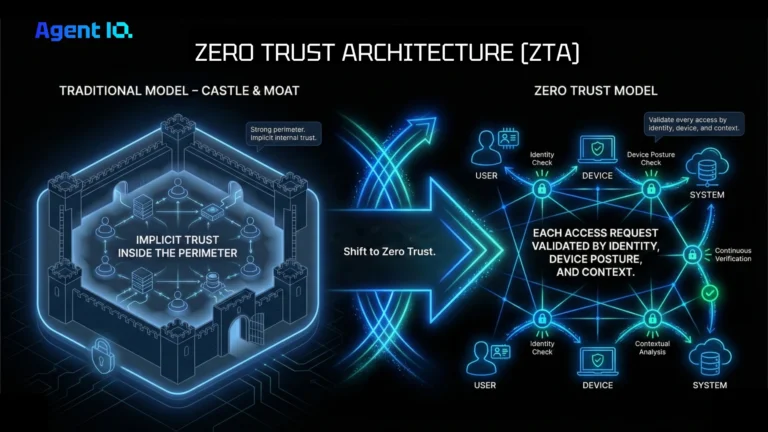
Traditional security models relied on a strong external perimeter (e.g., firewalls, VPNs), implicitly trusting entities within. This “castle-and-moat” approach is ineffective in modern environments with cloud services and remote work. Zero Trust shifts the focus to establishing trust based on identity, device posture, and context for each individual access request.
Why Zero Trust Architecture Matters Today
ZTA is crucial for addressing current and future cybersecurity challenges:
Addressing the Modern Threat Landscape:
- Remote Work: Secures access from diverse, potentially untrusted networks.
- Cloud Adoption: Protects data and applications outside traditional on-premise infrastructure.
- Insider Threats: Mitigates risks from malicious or compromised internal users.
- Sophisticated Cyberattacks: Defends against ransomware, phishing, and advanced persistent threats that bypass perimeter defenses.
Minimizing Attack Surface and Preventing Lateral Movement:
ZTA’s granular controls and microsegmentation limit exploitable points and prevent attackers from spreading within the network after an initial breach.
These threats contribute to increasing cybercrime rates and data breaches globally.
Principles of Zero Trust
Never Trust, Always Verify
Treat all users, devices, applications, and networks as untrusted by default.
Least Privilege Access (JIT/JEA)
Grant users only the minimum access rights and duration necessary for their tasks. Just-in-Time (JIT) and Just-Enough Access (JEA) reduce potential damage from compromised accounts.
Assume Breach
Design security controls assuming a breach is inevitable, focusing on quick detection, containment, and minimizing impact.
Context-Aware and Adaptive Access Policies
Access decisions are dynamic, based on real-time evaluation of user identity, device health, location, time, behavior, and resource sensitivity.
Microsegmentation
Divide the network into smaller, isolated segments, controlling traffic flow to limit an attacker’s lateral movement if one segment is compromised.
Continuous Monitoring and Validation
Continuously monitor and analyze all network traffic, user behavior, and device states for anomalies and suspicious activities. Verification is ongoing.
Authenticating and Authorizing Everywhere
Enforce authentication and authorization at every access point to every resource, encompassing user-to-application, application-to-application, and machine-to-machine communications.
Key Components of a Zero Trust Architecture
Identity and Access Management (IAM)
IAM is the foundation of ZTA, ensuring only verified identities access resources.
- Multi-Factor Authentication (MFA): Requires two or more proofs of identity for strong verification.
- Single Sign-On (SSO): Allows a single authentication to access multiple applications.
- Behavioral Analytics: Uses AI/ML to detect unusual user or device behavior.
Device Security and Posture Validation
Ensures all devices attempting to access resources are healthy, compliant, and authorized.
- Endpoint Detection and Response (EDR): Continuously monitors endpoint activity for malicious behavior.
- Compliance and Health Checks: Assesses device security posture (e.g., OS updates, antivirus status).
Network Security
Controls and segments network access.
- Microsegmentation: Isolates workloads, applications, or functions within a network.
- Zero Trust Network Access (ZTNA): Replaces traditional VPNs, providing secure, adaptive, and granular access to specific applications.
- Software-Defined Perimeters (SDP): Creates secure, encrypted connections between users/devices and resources, making resources invisible to unauthorized users.
Application and Workload Security
Extends Zero Trust principles to applications and workloads.
- API Security: Secures application programming interfaces (APIs).
- Runtime Protection: Protects applications during execution.
Data Security
Protects sensitive data throughout its lifecycle.
- Data Classification: Identifies and categorizes data by sensitivity.
- Encryption (Data at Rest and in Transit): Protects data during storage and transmission.
- Data Loss Prevention (DLP): Detects and prevents sensitive data from leaving the organization.
Visibility, Analytics, and Automation
Provides intelligence and agility for effective ZTA.
- Security Information and Event Management (SIEM): Collects and analyzes security logs.
- Security Orchestration, Automation, and Response (SOAR): Automates routine security tasks and orchestrates incident response workflows.
Benefits of Adopting Zero Trust Architecture
Enhanced Security Posture
Reduces overall cybersecurity risk by eliminating implicit trust and enforcing rigorous validation.
Reduced Attack Surface
Granular access controls and microsegmentation minimize potential entry points and exposure.
Improved Threat Detection and Response
Continuous monitoring and real-time analytics enable faster identification and containment of breaches.
Prevention of Lateral Movement
Microsegmentation isolates compromised areas, preventing attackers from moving freely across the network.
Better Protection for Remote Work and Cloud Environments
Provides consistent security regardless of user or resource location, suitable for hybrid work and multi-cloud strategies.
Simplified Compliance and Auditing
Granular control and automated policy enforcement simplify adherence to regulatory requirements, helping businesses meet stricter data protection regulations.
Zero Trust Architecture Use Cases
| Use Cases | Detail |
|---|---|
|
Securing Remote Workforces |
Enables secure, granular access to corporate resources, often replacing traditional VPNs with ZTNA. |
|
Mitigating Insider Threats |
Least privilege access and continuous monitoring prevent malicious insiders from accessing unauthorized data. |
|
Protecting Cloud Environments and SaaS Applications |
Extends Zero Trust security policies to cloud-native applications, IaaS, PaaS, and SaaS. |
|
Securing IoT/OT Devices |
Isolates vulnerable IoT and OT devices using microsegmentation to prevent exploitation. |
|
Supply Chain Security |
Strictly controls and monitors access for third-party vendors to mitigate risks. |
Challenges and Considerations
Complexity of Implementation
ZTA requires significant re-architecting of security strategy and integration of multiple technologies. 35% of organizations cite complex legacy infrastructure as a major barrier.
Organizational Culture and Training
Employees and IT teams may resist changes. Comprehensive user education and ongoing training are required.
Cost and Resource Allocation
Initial investment in new technologies and skilled personnel can be substantial. Ongoing maintenance and specialized expertise are also necessary. The ROI message is reiterated for SMEs, framing it as a strategic investment to avoid larger breach costs.
FAQs
What are the core principles of Zero Trust Architecture?
The core principles include “Never Trust, Always Verify,” Least Privilege Access, Assume Breach, Context-Aware and Adaptive Access Policies, Microsegmentation, Continuous Monitoring and Validation, and Authenticating and Authorizing Everywhere.
How does Zero Trust differ from traditional security models?
Traditional security models implicitly trust entities inside a defined network perimeter, focusing on external threats. Zero Trust assumes no implicit trust, enforcing strict authentication and authorization.
What are the benefits of adopting a Zero Trust approach?
Benefits include enhanced security posture, reduced attack surface, improved threat detection and response, prevention of lateral movement, better protection for remote work and cloud environments, and simplified compliance and auditing.
Transform Your Knowledge Into Assets
Your Knowledge, Your Agents, Your Control
Your Knowledge, Your Agents, Your Control